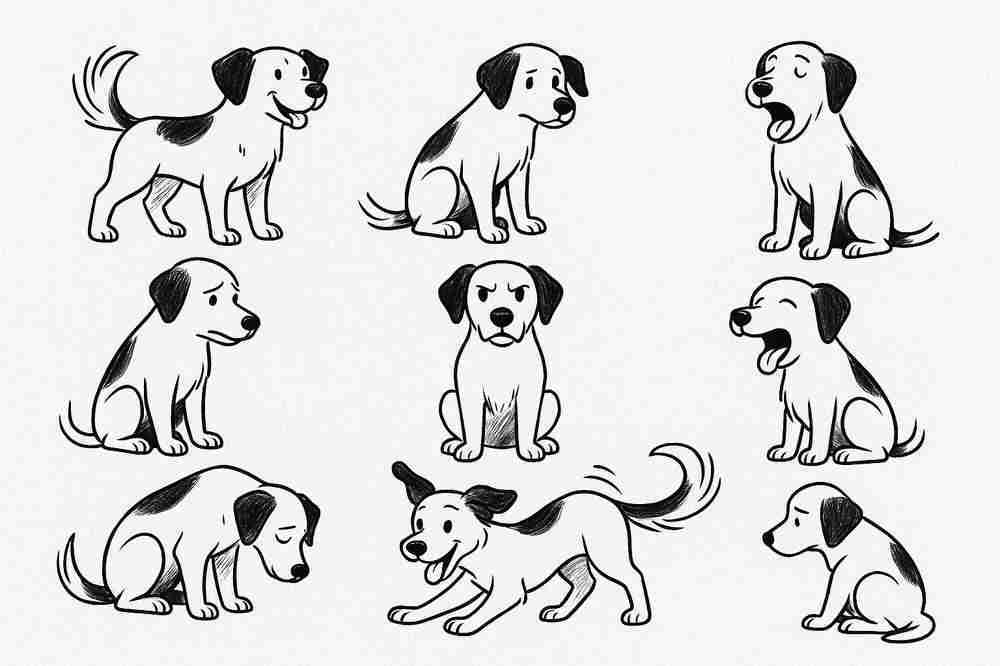

Understanding your dog’s body language
Inhalt
What he really wants to tell you 🐶💬
Dogs don’t talk with words, but with their whole body. If you understand this, you have a clear advantage – because this is the only way to know how your four-legged friend is feeling: Is he feeling well? Is he nervous? Or does he just need some peace and quiet?
Why body language is so important for dogs
Dogs have a keen sense of their environment – and of you. They “speak” with their ears, eyes, tail, body tension and small gestures. If you can read this, trust and security develop. This is how good communication turns into real friendship.
The basics of body language
🐕 Tail wags loosely: Happy dog!
🐕 Tail stiff or down: Caution – tension, uncertainty or stress.
👂 Ears forward: awake and alert – what’s happening here?
👂 Ears laid back: Your dog feels insecure or anxious.
👀 Direct eye contact: Curiosity – but can also be demanding or threatening.
😮💨 Yawning, looking away, licking lips: typical calming signals. Although this can also indicate a sour stomach.
Frequent misunderstandings
❌ “He’s wagging – so he’s happy.” Not always. Even an insecure dog sometimes wags.
❌ A stare is not always affectionate – sometimes it’s more like: “Watch out!”
❌ Many people overlook yawning, licking, looking away – these are often clear signs: “I need a break.”
❌ Forcing a cuddle even though the dog walks away? Please don’t. Give him space.
Further signals
Body tension & posture
- Loose, soft, slightly springy: relaxed and in a good mood.
- Stiff, tense, frozen: Alertness, uncertainty or fear.
- Weight shifted to the front: vigilance or confrontation.
- Weight back, ducks: retreat, fear or appeasement.
- Sudden freezing in motion: The dog scans a situation – Attention!
Face & Mouth
- Mouth loosely open, slight panting: Relaxed.
- Mouth closed, tense: Concentration, uncertainty or stress.
- Show teeth with a growl: A clear warning.
- Show teeth without growling (so-called grin): Can mean play or nervousness – pay attention to the rest of the body language!
Eyes
- A soft, relaxed look: Satisfaction.
- Eyes wide open, “whites of eyes visible” (whale eye): Fear, insecurity or excessive demands.
- Wink: calming signal, can have a calming effect.
- Stare: threat or uncertainty – pay attention to context.
Tail (tail)
- High, stiff, wags slowly: tension, possibly dominance behavior.
- Between the legs, retracted: Fear or insecurity.
- Circling with the whole hip: enthusiasm, often at a reunion.
Further signals
- Raise paw: Uncertainty, concentration or appeasement.
- Shake yourself (without being wet): Stress relief or transition from tension to relaxation.
- Turn away or walk away: “I need some peace and quiet.”
- Lying down with head turned away: Withdrawal, disinterest or reassurance.
Your mini-training – this is how you learn to speak dog:
1️⃣ Observe your dog in everyday life. How does he act when he is relaxed?
2️⃣ Pay attention to differences – how does his behaviour change under stress?
3️⃣ Practice recognizing small signals.
4️⃣ Respond with respect – your dog will thank you for it.
5️⃣ Get tips from dog trainers or directly from holawuff.com
Want to know how well you understand your dog? Then take our Holawuff quiz now!
A contribution from DoggyVibes, Holawuff